Amid the rapid development of the global food and health industry, organic mushroom extracts have been widely used in functional foods, dietary supplements, health drinks and other sectors thanks to their natural effects of immune regulation, cognitive enhancement and anti-aging. According to industry data, the global functional mushroom extract market exceeded 8 billion US dollars in 2024 and is projected to reach 21 billion US dollars by 2030, with a compound annual growth rate of over 17%. North America and Europe are the core consumer markets, while the Asia-Pacific region leads in growth rate. For players in the food and health industry, choosing a high-quality and reliable supplier of organic mushroom extracts directly determines product quality and efficacy, and is also critical to brand reputation, market competitiveness and compliance risks. Based on industry practices and global regulatory requirements, this article sorts out the core dimensions for selecting high-quality suppliers to help with precise screening and efficient cooperation.
I. Qualification Certifications: The Basic Threshold for Compliance and Quality
The quality of organic mushroom extracts starts with compliant production and control systems, and authoritative qualification certifications are the most direct screening criteria. For enterprises targeting the global market, priority should be given to verifying whether suppliers hold certifications covering multiple regions to ensure smooth market access for products.
Core certifications shall cover two dimensions: organic attributes and production compliance.
For organic certification, confirm that suppliers possess globally recognized organic credentials such as EU Organic Certification (EU COI) and USDA National Organic Program (NOP) Certification. In some cases, Japanese Organic Certification and China Organic Certification are also required to ensure compliance with organic standards throughout raw material cultivation and processing, eliminating pesticides, fertilizers, hormones and other artificial additives.
For production compliance, suppliers must hold food safety management system certifications including GMP (Good Manufacturing Practice), HACCP (Hazard Analysis and Critical Control Points), ISO22000 and ISO9001. Suppliers of high-end products may also need FSSC 22002 certification to guarantee clean production workshops, traceable production processes and closed-loop quality control.
In addition, special certifications are required to meet regulatory requirements in different global markets: FDA registration for exporting to North America, and Halal certification for Islamic countries. Meanwhile, suppliers shall be required to provide complete qualification documents and third-party Certificates of Analysis (COA) for each batch, which clearly specify key indicators such as active ingredient content, heavy metals, pesticide residues and microorganisms to ensure compliance with market regulatory standards.
II. Controlling Raw Materials and Cultivation Bases Determines Intrinsic Product Quality
The efficacy of organic mushroom extracts lies in their natural active ingredients, and raw material quality directly determines the purity and effectiveness of extracts. High-quality suppliers inevitably maintain strong control over the raw material end, realizing standardized and organic management from strain cultivation to harvesting.
First, focus on raw material source and quality.
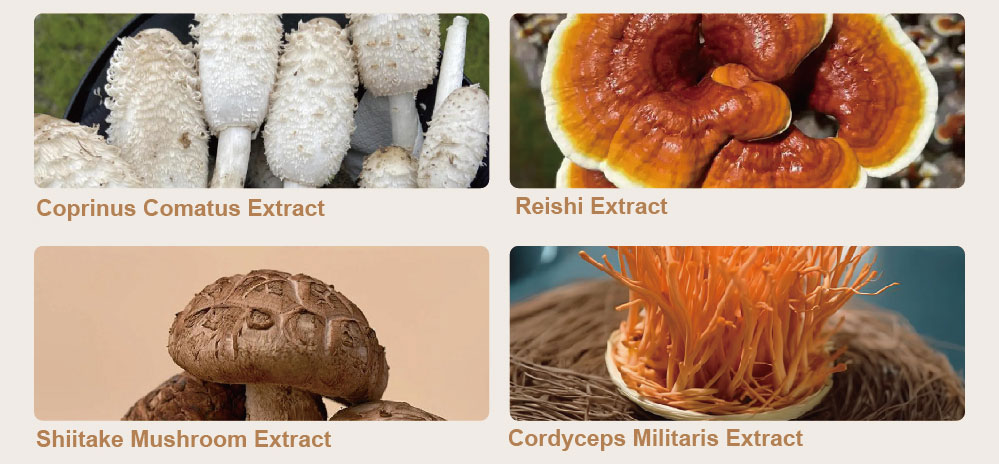
High-quality suppliers prioritize 100% pure mushroom fruiting bodies as raw materials and reject mycelium or mixed contaminated materials to ensure the concentration and stability of active ingredients. For example, key active ingredients of ganoderma lucidum extract (ganoderma triterpenes, beta-glucans) and hericium erinaceus extract (hericenones, erinacines) are most abundant in fruiting bodies with clear efficacy. Meanwhile, verify that raw material strains are strictly screened and identified via gene sequencing to prevent contamination by foreign bacteria.
Second, check the compliance and standardization of cultivation bases.
High-quality suppliers shall own self-operated organic cultivation bases or maintain long-term stable cooperation with certified organic bases. Bases must be far from industrial pollution, with soil, water and air meeting organic cultivation standards, and equipped with a complete cultivation traceability system to track planting time, plots and cultivation methods of each batch. Organic farming practices shall be followed without chemical pesticides, fertilizers or growth regulators; natural compost and biological control are used to avoid pollutant residues. For instance, high-quality organic agaricus blazei murill extract must meet the green industry standards for import and export of medicinal plants and preparations, with cadmium (Cd) ≤0.13μg/g and arsenic (As) <0.20μg/g.
III. Extraction Technology and Technical Strength Ensure Efficacy and Stability
Extraction technology is the core of organic mushroom extract production. Advanced technologies maximize the retention of active ingredients, improve purity, reduce impurities and solvent residues, and ensure consistent batch quality — this is the key difference between premium and average suppliers.
Prioritize suppliers adopting advanced extraction techniques, including dual extraction (hot water + alcohol), supercritical CO₂ extraction and low-temperature enzymatic hydrolysis.
Dual extraction captures both water-soluble (e.g., polysaccharides) and fat-soluble (e.g., triterpenes) active ingredients for full-spectrum extraction and enhanced overall efficacy.
Supercritical CO₂ extraction operates under low-temperature and oxygen-free conditions, effectively preserving heat-sensitive ingredients and eliminating organic solvent residues, ideal for high-end products.
Low-temperature enzymatic hydrolysis breaks mushroom cell walls to boost dissolution and bioabsorption of active ingredients.
Also, evaluate production equipment and technical control capabilities.
High-quality suppliers are equipped with fully automated extraction systems to precisely control temperature, time, solvent ratio and other parameters, minimizing human error and ensuring batch consistency. They should also have a professional R&D team and industry-university-research cooperation, capable of optimizing processes and developing new products (e.g., brain-health formulas with hericium erinaceus + ginkgo biloba, immune-support blends with lentinus edodes + inonotus obliquus) to support differentiated product development.
IV. Testing System and Quality Control Ensure Product Safety
Product safety is the bottom line for the food and health industry, and a sound testing system and strict quality control are core capabilities of reliable suppliers. High-quality suppliers implement full-process testing from raw material incoming inspection to finished product delivery to eliminate non-conforming products.
Testing items must fully cover active ingredients, safety indicators and physical/chemical indicators. Active ingredients shall be accurately quantified using standardized methods.
Suppliers must have an ISO/IEC17025-accredited laboratory equipped with advanced instruments (ICP-MS, HPLC, GC-MS/MS) for in-house testing of core indicators, with verification by third-party authorities to ensure authenticity and reliability. Batch management systems are required, with independent production and testing archives for full traceability, enabling rapid localization and resolution of any issues.
V. Long-Term Cooperation: Supply Chain and Service Capabilities Ensure Efficient and Stable Collaboration
For global food and health enterprises, supply chain stability and service capabilities of suppliers directly affect production planning and market delivery. Selection should balance capacity, delivery and value-added services for win-win long-term cooperation.
Supply Chain Stability
Check annual raw material processing capacity (preferably over 600 tons), standardized workshops and complete warehousing.
Top suppliers may set up overseas warehouses in core markets to shorten lead times, improve responsiveness and reduce logistics costs and risks.
Confirm stable raw material channels to cope with market fluctuations and seasonal changes and avoid production disruptions.
Service Capabilities
High-quality suppliers provide comprehensive value-added services:
Customized product specifications (varying active ingredient content, dosage forms)
Complete technical support (application solutions, efficacy verification data)
Assistance with compliance filings (e.g., EU Novel Food listing)
Timely consultation and after-sales support
Diversified product portfolios (organic mushroom extracts + nerve acid, dihydroquercetin and other specialty ingredients) for one-stop procurement and lower supply chain management costs.
VI. Core Traits of High-Quality Suppliers and Selection Recommendations
In summary, high-quality organic mushroom extract suppliers feature complete compliance qualifications, strict raw material control, advanced technology, sound testing systems, stable supply chains and strong service capabilities.
Enterprises should follow the logic: verify qualifications → control raw materials → evaluate technology → assess services, and prioritize suppliers with full-industry-chain control (strain breeding, organic cultivation, extraction, testing and delivery all in-house) to ensure quality, safety, efficiency and risk reduction.
Recommendations before formal cooperation:
Request samples for third-party testing to verify consistency with COAs.
Conduct on-site inspections of cultivation bases, workshops and laboratories to assess production control.
Against the backdrop of expanding global organic mushroom extract market and tightening regulations, selecting a high-quality supplier safeguards product quality and becomes a core competitiveness for enterprises to seize market opportunities and achieve sustainable development.
 English
 français
 Deutsch
 Español
 русский
 português
 日本語
日本語