English
 français
 Deutsch
 Español
 русский
 português
As a classic herb in Ayurvedic medicine, Ashwagandha (also known as Indian Ginseng) exhibits unique value in anti-inflammation, antioxidant, anxiety relief, and sleep improvement due to its core active ingredients such as withanolides and withanosides. It has become a popular raw material in the modern health industry. However, conventional Ashwagandha extracts have long been plagued by two major pain points: poor solubility and significant bitterness, which strictly limit their application scenarios to traditional dietary supplements such as capsules and tablets. With the technological breakthroughs of water-soluble debittered Ashwagandha extracts like NF Ashwa®, this ancient herb has achieved a leap from "medicinal supplements" to "daily consumption", spawning a series of innovative application scenarios and redefining the value boundary of Ashwagandha in the health industry.
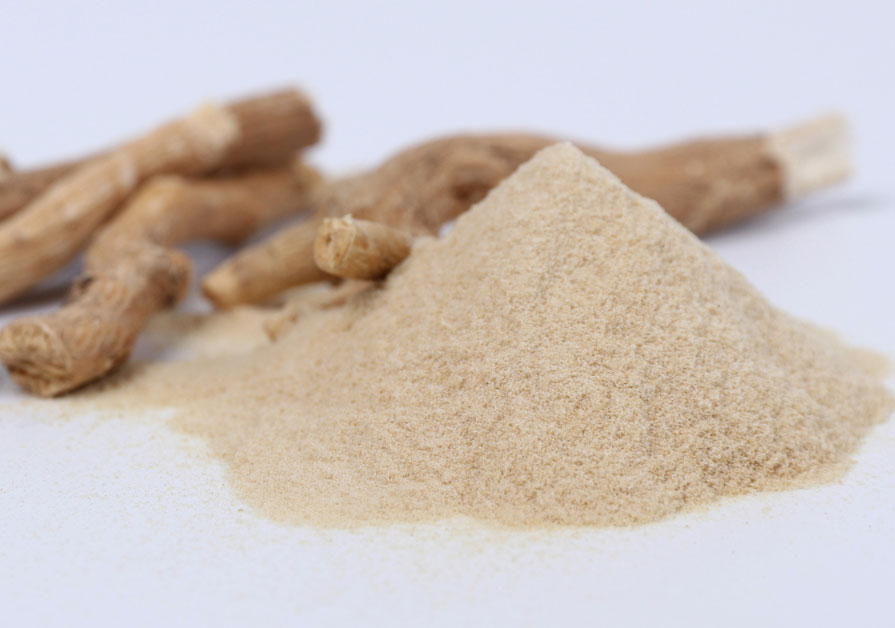
The core active ingredients in conventional Ashwagandha extracts (such as withaferin A derivatives and withanolides) are mostly fat-soluble or poorly soluble substances. When added to aqueous systems, they are prone to precipitation and caking, which not only damage the appearance and texture of the product but also reduce the absorption efficiency of the ingredients. This has made it impossible for large-scale application in large consumer sectors such as functional beverages and oral liquids. Through precise extraction process optimization and solvent system regulation, water-soluble debittered Ashwagandha achieves rapid and uniform dispersion in aqueous environments, with a clear and transparent solution free of impurities, completely breaking the solubility barrier of traditional Ashwagandha.
This breakthrough has directly given birth to a variety of innovative functional beverages: "sleep-soothing drinks" targeting anxiety and insomnia in urban populations, which combine water-soluble debittered Ashwagandha with jujube seed and gamma-aminobutyric acid to create portable pre-sleep oral liquids, avoiding the precipitation problem of conventional Ashwagandha oral liquids; "energy recovery drinks" for sports populations, which combine electrolytes with water-soluble Ashwagandha ingredients to help physical and mental relaxation and functional recovery after exercise; even in normal-temperature ready-to-drink herbal teas, Ashwagandha ingredients can be stably added to achieve the dual needs of "daily hydration + gentle conditioning". These applications not only expand the consumption scenarios of Ashwagandha but also cater to modern consumers' demand for "convenient and lightweight" health products, promoting Ashwagandha from "niche supplements" to "mass consumer goods".
Ingredients such as withaferin A, tannins, and quinic acid in conventional Ashwagandha extracts have a strong bitter taste. Even a small amount of addition will significantly affect the product taste, making it difficult to land in fields that focus on flavor experience such as gummies, dairy products, and baked goods. Through the dual technical path of "targeted removal + physical encapsulation", water-soluble debittered Ashwagandha achieves precise control of bitterness: on the one hand, high-bitterness withaferin A is quantitatively removed through a stepwise extraction process (controllable below 0.1% or even 0.01%); on the other hand, for the remaining slight bitterness, physical technologies such as cyclodextrin encapsulation and nano-liposomes are used for masking according to application scenarios. While retaining core active ingredients such as withanolides, a mild taste is achieved.
The optimization of taste has allowed Ashwagandha to integrate into more food categories: in the field of children's health food, probiotic gummies containing Ashwagandha ingredients have been launched, solving the problem of low acceptance of traditional supplements by children; in the dairy field, it is compounded with yogurt and lactic acid bacteria beverages to create dual-functional dairy products with "intestinal regulation + emotional soothing", and the elimination of bitterness makes their flavor the same as ordinary dairy products; in the baking field, water-soluble debittered Ashwagandha is added to whole wheat bread and energy biscuits to develop "stress-relief breakfast" series suitable for office workers, integrating health conditioning into daily diet. These innovative applications not only enrich the category choices of functional foods but also lower the consumption threshold for consumers, promoting the foodization process of herbal ingredients.
In addition to breakthroughs in solubility and taste, water-soluble bitter and intoxicated eggplant has also been upgraded in terms of bioavailability and precise efficacy. Through the combination of multiple components using the "co loaded liposome technology", water-soluble and bitter free Polygonatum sibiricum can promote the efficient conversion of Polygonatum sibiricum saponins and Polygonatum sibiricum lactones, and improve the absorption efficiency of active ingredients; At the same time, different carrier technologies are used to adapt to the subdivided scenes, such as liposome Ashwagandha for soft capsules and oral liquids, to further optimize the efficacy.
This advantage enables it to accurately match the nutritional needs of different populations: in the field of sports nutrition, it has developed a drunken eggplant energy gel that is suitable for high-intensity training, quickly relieving exercise fatigue and regulating the body's state; In the field of women's health, we have launched an oral beauty product that combines water-soluble eggplant with collagen, achieving a dual effect of "anti anxiety+antioxidant"; In the field of elderly health, we aim to develop low-dose and easily absorbable Zhuqie oral liquid to assist in regulating immunity and improving sleep quality. In addition, with quality control advantages such as USP standard calibration and HPLC active ingredient detection, water-soluble bitter intoxicated eggplant also meets the strict requirements of the international market for herbal raw materials, providing stable raw material support for the development of cross-border functional foods.
The emergence of water-soluble debittered Ashwagandha essentially solves the industrial application pain points of traditional herbal raw materials through technological innovation. From breaking the water solubility barrier to unlock the beverage track, to solving the bitterness problem to empower diversified food innovation, and then to upgrading bioavailability to match segmented needs, each innovative application originates from precise insight into consumer needs and continuous breakthroughs in technological boundaries. With the continuous upgrading of the health consumption market, water-soluble debittered Ashwagandha not only opens up a new path for the industrialization development of Ashwagandha raw materials but also provides a referable technical paradigm for the integration of herbal ingredients with modern food and beverages, allowing ancient herbs to radiate new vitality in the new era.