English
 français
 Deutsch
 Español
 русский
 português
 日本語
日本語
As a globally recognized core raw material for sports nutrition, creatine monohydrate enjoys sustained and rapid market expansion. However, conventional regular-mesh creatine suffers from poor solubility, gritty taste, gastrointestinal irritation, sedimentation and stratification of finished products, which hinders the development of functional drinks, protein powders, instant solid granules and dietary supplement foods. This article focuses on two upgraded raw materials—micronized creatine monohydrate and instant creatine monohydrate. It compares performance gaps with traditional creatine, unpacks core technological advantages of jet milling and hydrophilic coating granulation, and presents real-world application cases across multiple food and beverage scenarios. It delivers a complete solution for sports nutrition brands, functional food manufacturers and liquid beverage producers covering raw material selection, differentiated product development and market profit upgrading, catering to all market channels including cross-border e-commerce, offline fitness retail and mass health consumer goods.
Data shows the global creatine market reached USD 620 million in 2026 and is projected to hit USD 1.314 billion by 2035, with a compound annual growth rate (CAGR) of 8.70%. China’s market growth far outpaces the global average at a CAGR of 22.3%, exceeding RMB 5 billion in market size in 2026. Two core shifts have reshaped consumer demand:
Consumer Group Expansion: Creatine has broken out of the niche professional fitness circle and extended to daily supplementation for anti-fatigue, cognitive improvement and anti-aging. Research from Harvard Medical School verifies creatine’s efficacy in relieving brain fog and boosting cognitive function, broadening target audiences for food and beverage products.
Demand Upgrade: Consumers no longer prioritize efficacy alone; drinking experience has become a key purchasing factor, including dissolution speed, smooth mouthfeel, zero sediment and mild gastrointestinal tolerance.
Conventional 80-mesh / 200-mesh creatine monohydrate only has a solubility of 13g/L at room temperature, creating unavoidable drawbacks in liquid beverage production, solid powder manufacturing and end-consumer drinking experience—core barriers to R&D and repeat purchases for food and beverage manufacturers:
Caking & Sedimentation Issues: Poor powder dispersibility lowers mixing efficiency on production lines. Finished products leave heavy undissolved residues at the bottom of cups or bottles after standing, causing turbidity and stratification in canned sports drinks and damaging product appearance.
Gritty, Chalky Mouthfeel: Undissolved microcrystals suspend in liquid, leaving a sandy, chalky aftertaste that clashes with fruit and dairy flavors, drastically reducing consumer willingness to repurchase long-term.
Gastrointestinal Discomfort Risks: Large particles digest and absorb slowly, easily triggering bloating, flatulence and mild diarrhea when consumed on an empty stomach or post-workout. Poor tolerance among consumers with sensitive guts narrows product applicability.
Leading international sports nutrition brands including Optimum Nutrition, Myprotein and MuscleTech have fully adopted micronized and instant creatine raw materials to build product differentiation via technological upgrades and seize both high-end and mass market segments. For food and beverage manufacturers, switching to upgraded creatine raw materials is the core strategy to build brand moats.
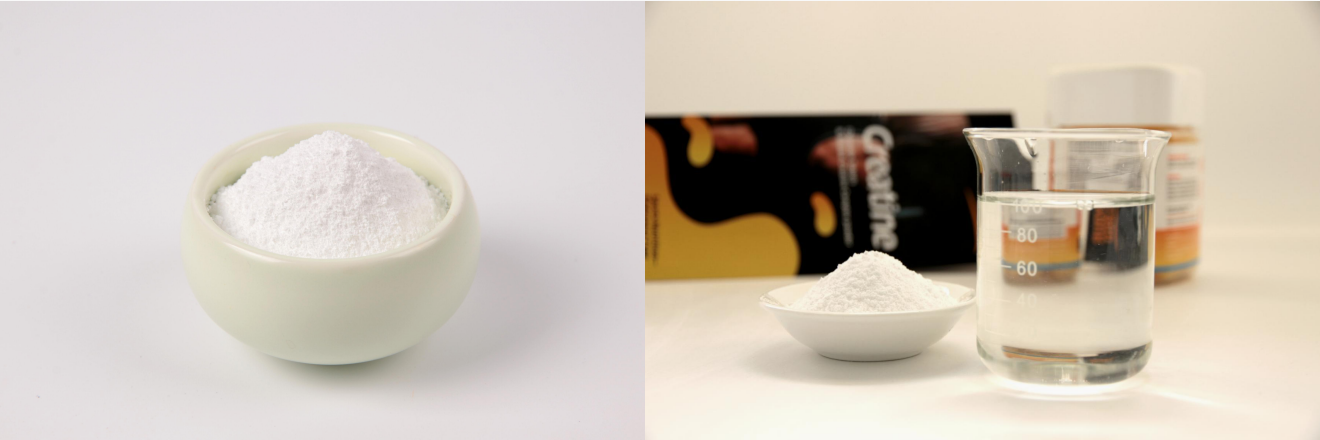
Supported by two core technologies—jet milling and hydrophilic coating granulation—micronized and instant creatine eliminate solubility, mouthfeel and absorption drawbacks of traditional creatine at the physical particle level. Both comply with USP (United States Pharmacopeia) standards, CNAS lab testing requirements and FSSC 22000 food safety system certification, supporting compliant production for cross-border and domestic food & beverage markets worldwide.
Conventional 200-mesh creatine is refined into ultra-fine powder of 1000–2000 mesh with uniform particle size distribution, drastically increasing specific surface area to fundamentally boost liquid dispersibility. No extra coating additives are applied, maintaining a clean label with 100% pure creatine monohydrate, ideal for brands pursuing minimal ingredient lists.
Strong Production Compatibility: No high-shear or prolonged stirring required to improve line mixing efficiency and cut equipment energy consumption. Bulk density ranges from 0.15–0.25g/ml with excellent powder fluidity, preventing blockages during powder filling and tablet pressing.
Optimized Dissolution Performance: Fully dispersible with normal stirring within 1–3 minutes in room-temperature water, drastically reducing finished-product sedimentation and stable dispersion in cold water, acidic sports drinks and whey milkshakes.
Improved Mouthfeel & Absorption: Fine particles eliminate coarse grit for nearly zero sandy texture; easier digestion reduces bloating and diarrhea risks to accommodate gut-sensitive consumers.
Outstanding Cost Performance: Mature and stable production processes lower raw material procurement costs versus instant creatine, suitable for full-line upgrades of mid-tier sports powders and mass-market functional foods.
Surface modification is applied on micronized fine powder to adjust particle hydrophilicity, delivering instant full dissolution with zero residue—the optimal raw material solution to solve stratification and sedimentation challenges for bottled ready-to-drink (RTD) creatine beverages and premium protein milkshakes.
Ultimate Dissolution Experience: No vigorous shaking or sonication needed; fully disperses instantly in cold water for crystal-clear solutions with no visible precipitation after 24 hours of standing, perfectly suited for RTD bottled functional drinks and pouch-based instant liquid mixes.
Silky Residue-Free Mouthfeel: Fully eliminates chalky grit, compatible with fruit juices, dairy bases and sparkling sports drinks without disrupting original flavors to elevate premium product positioning.
Broad Formula Compatibility: Stable when compounded with whey protein, electrolytes, vitamins and fruit & vegetable extracts with no flocculation or discoloration, supporting development of multiple dosage forms including gummies, solid beverages and meal replacement shakes.
Differentiating High-End Label: Selling points of “instant dissolution, zero sediment, silky texture” serve as visual marketing highlights for short videos and live streaming, forming core competitive edges distinct from generic creatine products on the market.
| Test Indicator | Conventional 200-Mesh Creatine Monohydrate | Micronized Creatine Monohydrate | Instant Creatine Monohydrate |
|---|---|---|---|
| Powder Mesh Size | 200 mesh | 1000–2000 mesh | 200 mesh (granulation modified) |
| Dissolution at 25°C | Slow dissolution, heavy sediment, requires prolonged stirring | Good dissolution, dispersed in 1–3 mins with minor sediment | Ultra-fast dissolution, fully clear liquid with zero residue in 1–2 mins |
| Drinking Mouthfeel | Noticeable sandy, chalky grit | Fine texture with nearly no particle sensation | Silky smooth with zero coarse texture |
| Bulk Density | 0.45–0.55 g/ml | 0.15–0.25 g/ml | 0.45–0.55 g/ml |
| Matching Product Positioning | Low-end basic powders | Mid-tier sports powders, dietary supplement tablets | High-end liquid beverages, premium instant mixes, DTC internet-famous brands |
| Core Advantages | Low raw material cost | Cost-effective, clean label, mild absorption | Full dissolution without sediment, stable liquid formula, premium differentiation |
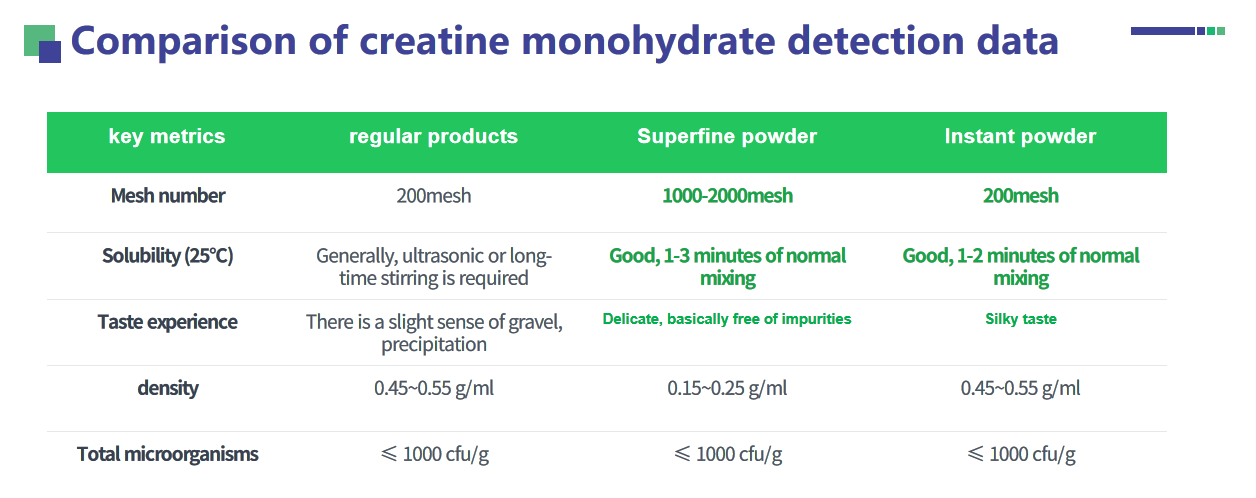
The two upgraded creatine raw materials precisely match product lines of different food & beverage manufacturers, covering existing product upgrading and new product R&D:
Existing Product Upgrade: Replace conventional creatine in current lines with micronized creatine; no production line adjustments required to upgrade product selling points, boost repeat purchases and lift single-item profit margins.
Premium New Product Lines: Launch high-end residue-free creatine and compound functional instant powders with instant creatine, highlighting “instant dissolution, zero sediment, silky mouthfeel” to match quality benchmarks of international brands like ON and MuscleTech and capture cross-border e-commerce and online retail channels.
Liquid formulations represent the biggest application challenge for creatine, as generic creatine easily stratifies and precipitates. Instant creatine monohydrate is the optimal solution:
Compatible with sports energy drinks, electrolyte sparkling water and bottled protein drinks with zero stratification or turbidity during long-term storage.
Reduces required stabilizer dosage to deliver clean-label formulas aligned with consumer demand for natural, low-additive products.
Micronized creatine’s ultra-fine particles avoid white speck defects during tableting and gummy production for uniform finished product appearance.
Gentle digestion and absorption enable development of brain-support supplements for middle-aged and elderly consumers and daily anti-fatigue meal replacements, breaking the stereotype that creatine is only for fitness enthusiasts and expanding target consumer groups.
Short videos and live streaming rely heavily on visual selling points. Instant and micronized creatine support intuitive comparison tests showing “instant cold-water dissolution, zero cup-bottom residue”, creating sharp visual contrast against generic creatine to drastically lift online conversion rates. Meanwhile, they meet mainstream overseas procurement demand for micronized and instant creatine.
Food and beverage manufacturers prioritize purity, safety and compliance for raw material procurement. Micronized and instant creatine monohydrate come with complete authoritative endorsements to avoid inspection and export risks for finished goods:
Purity Standards: Compliant with USP monographs; creatinine, heavy metals and unknown impurities are undetected, total impurities ≤2.0%, ignition residue ≤0.1%, eliminating long-term gastrointestinal burdens for consumers.
Microbial Control: In-house CNAS-accredited testing laboratories control total aerobic microbial count ≤10 CFU/g; E. coli, Salmonella spp. and Staphylococcus aureus are absent, meeting domestic GB 24154 sports nutrition food standards and import testing requirements for European and American markets.
System Certifications: Full production workflows certified by FSSC 22000 international food safety system. Batch COA test reports are provided to support customs clearance for cross-border brands and qualification reviews for domestic supermarket shelf entry.
Dual Inspection Mechanism: Double screening via internal enterprise QC and third-party re-inspection for full testing of purity, dissolution performance and microorganisms per batch, guaranteeing stable batch consistency and preventing mass quality defects of finished goods.
Affordable High-Volume Basic SKUs: Choose micronized creatine monohydrate for cost-effective product experience upgrades, outperforming low-end generic creatine competitors.
Mid-to-High-End Viral Instant Powders & Cross-Border Hit Products: Prioritize instant creatine monohydrate to build exclusive “instant zero-residue” core selling points supporting product premium pricing.
Bottled Liquid Beverages & RTD Ready-to-Drink Products: Instant creatine monohydrate is the only recommended option to resolve industry-wide sedimentation and stratification pain points for long-term liquid storage.
Tablets, Gummies & Solid Meal Replacement Foods: Micronized creatine features finer powder with superior processing compatibility and lower production costs.
Existing Customer Upgrading: For long-term partners purchasing conventional creatine, emphasize “product line upgrading & profit expansion”. Leverage visual dissolution comparison test data to demonstrate raw material advantages and strengthen customer stickiness.
Emerging DTC E-Commerce Brands: Supply dissolution comparison footage and short video shooting materials optimized for live streaming and graphic content marketing to amplify visual selling points of “zero sediment, silky mouthfeel”.
Premium Leading Sports Nutrition Brands: Deliver full sets of technical test reports and international compliance certifications to build differentiated brand competitiveness via raw material technological barriers and secure long-term cooperation partnerships.
China’s creatine market maintains a 22.3% ultra-high CAGR, with consumer demand shifting from “functional supplementation” to “premium consumption experience”. Solubility, mouthfeel and gastrointestinal irritation flaws of conventional creatine monohydrate have become major competitive disadvantages for finished products.Micronized creatine monohydrate delivers cost-effective clean-label performance for mid-tier mass-market food categories. Instant creatine monohydrate, with full instant dissolution and silky mouthfeel, overcomes formulation bottlenecks of liquid functional beverages and serves as the core raw material for high-end new products and cross-border bestsellers. By adopting these two technologically upgraded creatine monohydrate variants, food and beverage manufacturers can resolve formulation pain points at the production end, reduce quality control risks, develop perceptible differentiated selling points for consumers, and seize the huge market dividend of the mass health nutrition blue ocean.