At the 2026 FIC Forum, multiple sharing sessions focused on the construction of bio-based liposomes, molecular self-assembly mechanisms, multi-effect delivery systems and precise nutrient absorption. A clear trend has emerged: the industry is no longer debating "whether to use liposomes", but rather "how to build more efficient delivery systems".
I. Technological Discussions Are Upgrading
The industry's focus on liposome technology has gradually shifted from the aspects of "technical feasibility" such as single active ingredient, enhanced absorption rate of single ingredient, and small-scale technical verification in the laboratory, to "industrialization and application implementation capabilities" including multiple active ingredients, functional synergistic regulation, and stable commercial products. The industry's focus is moving from "whether to adopt liposomes" to "how to build a more efficient and commercially applicable delivery system". This marks that the application of liposome technology in the industry has entered a new stage.
II. Evolution of Technical Topics: From Technical Feasibility to Application Feasibility
Early research related to liposomes mostly focused on technical issues such as encapsulation efficiency, particle size control and basic stability. In the technical exchanges at this forum, the focus of discussions has obviously shifted, mainly reflected in the following aspects:
From single active ingredient loading to synergistic delivery of multiple active ingredients
From improving the absorption rate of single ingredients to functional regulation and synergistic effect enhancement
From small-scale laboratory verification to the feasibility of commercial production
This means that the evaluation criteria for liposome technology are gradually transitioning from "whether the technology is viable" to "whether the system has practical application value".
III. From Single Loading to Co-loading: The Core Challenge of Compound Delivery
In 2025, Natural Field Co., Ltd. released the
White Paper on Co-loaded Liposomes and delivered a speech entitled
New Breakthroughs in Compound Delivery: Co-loaded Liposomes Leading the Upgrade of Oral Anti-aging at the forum. Its core logic is to realize the synergistic loading and stable delivery of two or more active ingredients in the same liposome structure. The adjustment at the structural level is mainly reflected in the following application values:
Reducing the complexity caused by the coexistence of multiple carriers in the compound system
Improving the stability of synergistic delivery of multiple active ingredients
Providing higher flexibility for dosage form and formula design of terminal products
Against the backdrop of the industry's discussion on the "multi-effect delivery" path, the co-loading structure is regarded as one of the more feasible technical solutions.
IV. Delivery Reality in Anti-aging Applications
From the application perspective, anti-aging products usually involve multiple directions such as antioxidant support, mitochondrial energy metabolism, inflammatory regulation and cellular signal pathways. A single active ingredient is difficult to cover all action pathways, making compound design an inevitable choice.
In this context, the structural rationality of the delivery system directly affects the synergistic effect of multiple active ingredients. Co-loaded liposomes provide a structural solution for compound anti-aging products, rather than just staying at the level of ingredient combination. The technical discussions at the FIC Forum indicate that the delivery system is entering a stage of "structural optimization + synergistic design". Next, the real question the industry needs to answer is: who has the production capacity for large-scale, stable and cost-controllable co-loaded delivery products? This question may become the key to the further development of multi-effect delivery technology.
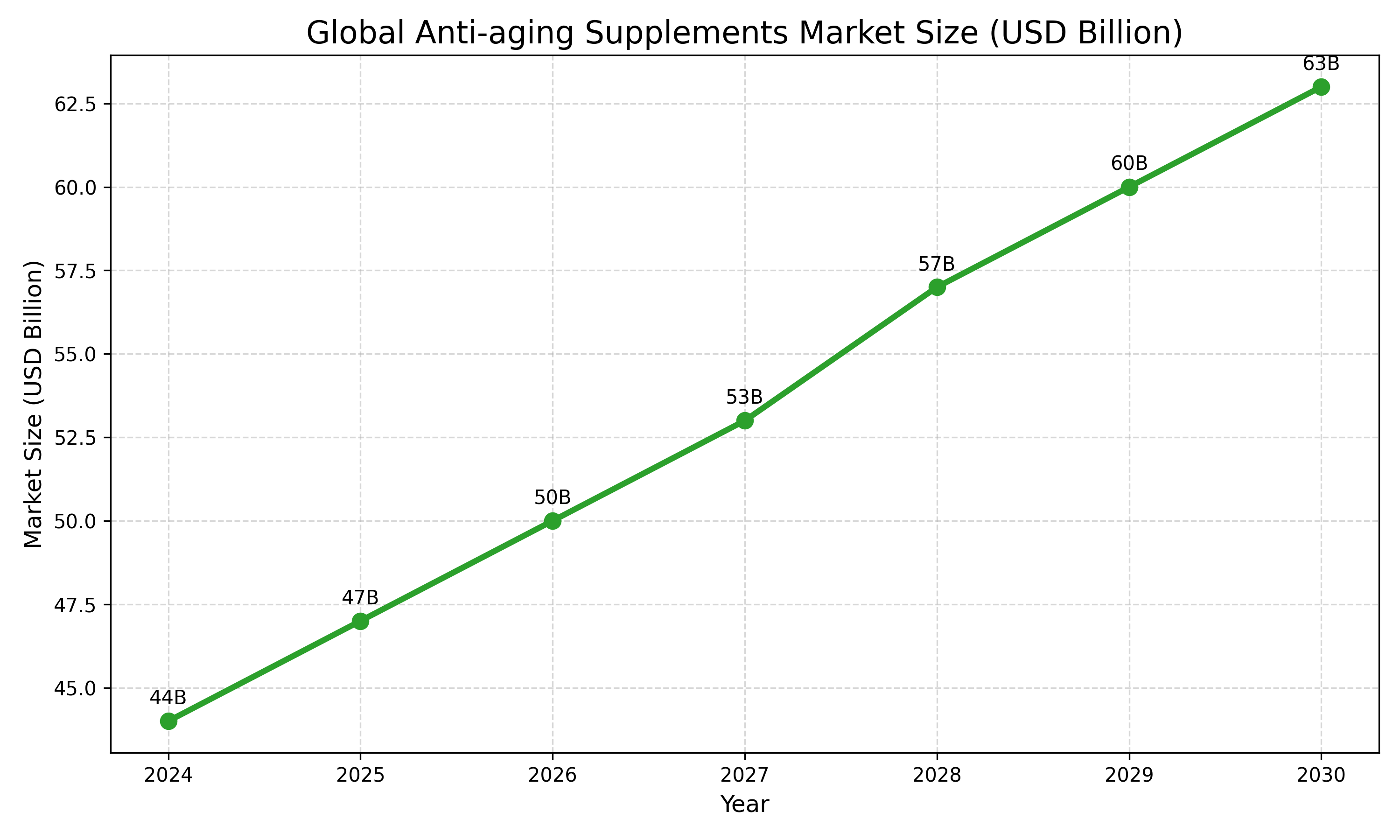
Global Anti-aging Supplement Market Size
 English
 français
 Deutsch
 Español
 русский
 português
 日本語
日本語